

If you’re lucky enough to spot a group of giant otters (Pteronura brasiliensis) on your Amazon trip, you’re in for a real treat. These charismatic and playful animals are known for their social behavior, hunting prowess, and unique appearance.
Giant otters are the largest species of otter in the world, with some individuals growing up to 1.8 meters (6 feet) in length and weighing up to 34 kilograms (75 pounds). They are found in the Amazon basin, including in the Cuyabeno Wildlife Reserve in Ecuador, and are known for their distinctive appearance, with brown fur and a white throat and chest.
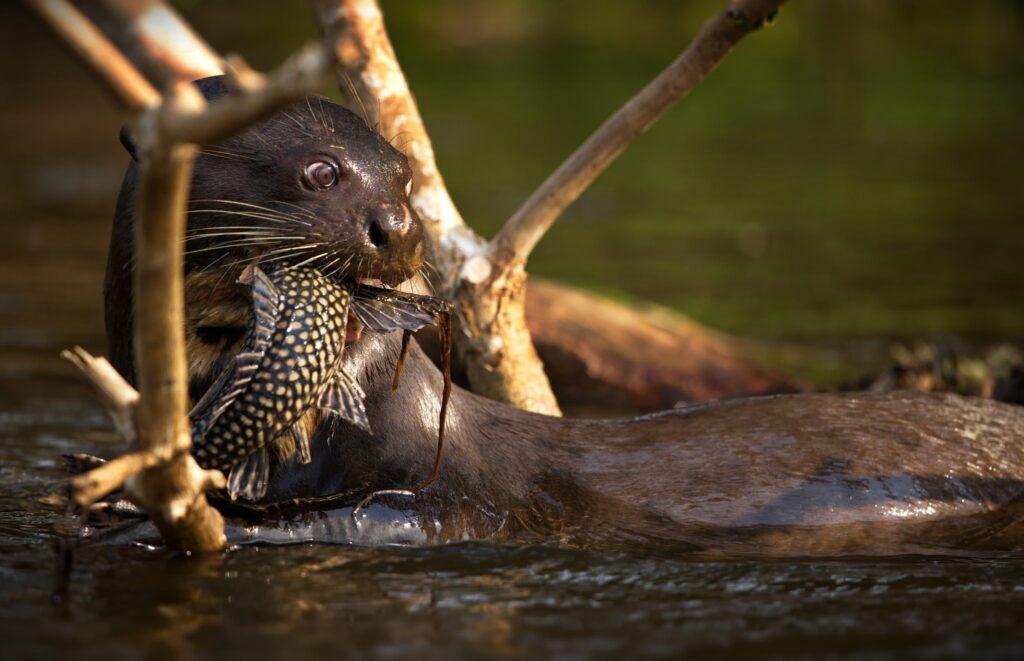
One of the most remarkable things about giant otters is their social behavior. They live in family groups of up to 8 individuals, with a dominant breeding pair and their offspring. They communicate with a wide range of vocalizations and are known to engage in playful behavior, such as sliding down muddy riverbanks and wrestling with each other.
In addition to their playful side, giant otters are also formidable predators. They are skilled hunters, and their diet consists mainly of fish, which they catch with their sharp teeth and powerful jaws. They are also known to occasionally hunt larger prey, such as caimans and anacondas.
Despite their many fascinating qualities, giant otters are unfortunately endangered. Their populations have declined due to habitat destruction, pollution, and hunting. They are sometimes hunted for their fur, and are sometimes seen as a threat to fish stocks and thus are hunted by humans.
If you’re lucky enough to see giant otters on your Amazon trip, it’s important to appreciate these amazing animals and support their conservation. You can do this by learning more about the threats facing them and supporting organizations working to protect them, such as the Giant Otter Project and the International Otter Survival Fund. With your help, we can work to ensure that these unique and endearing predators continue to thrive in the Amazon for generations to come.
 English
  Español
  Deutsch
  Français
  Italiano
  Português do Brasil
  Polski